


Can You Put Speakers on a Floating Shelf? Weight, Depth and Placement
Putting a speaker on a floating shelf seems straightforward. There is an empty spot on the wall, the speaker fits, and the cables can run behind it. But speakers are heavier, deeper and more active than most objects placed on shelves. They also produce vibration while in use.
That does not mean a floating shelf cannot hold a speaker. It means you need to check more than the speaker's weight before drilling into the wall.
Start With the Speaker's Weight
Speakers are deceptively heavy for their size. Even a compact bookshelf speaker contains a magnet, drivers and a dense cabinet. Before choosing a shelf, check the weight of the individual speaker rather than the packaged weight of the pair.
You also need to include anything else that will share the shelf. An amplifier, books or decorative objects all count towards the total load.
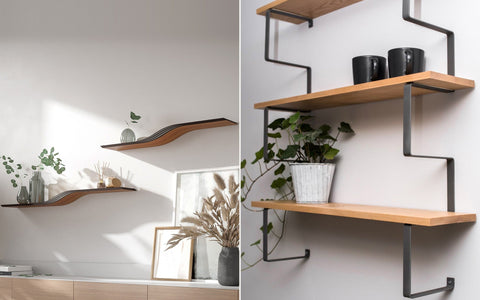
Our Wave floating shelf has a maximum stated capacity of 5 kg when correctly installed. However, that number alone does not confirm that a particular speaker is suitable.
A shelf's capacity normally assumes that the load is reasonably distributed. A speaker places most of its weight within a much smaller footprint. Its position matters too. A speaker placed close to the wall and mounting points creates a different load from one positioned near the outer edge.
Leave a reasonable safety margin rather than choosing a speaker that reaches the shelf's exact maximum capacity.

The Speaker Must Sit on a Level Surface
Weight is only the first check. The speaker's feet must also make full and stable contact with the shelf.
This is particularly important when considering a sculptural or curved shelf. If the speaker rocks, tilts or sits partly on a curved section, the shelf is not suitable for that speaker, even when the weight is below the stated limit.
The Wave shelf may work for a small speaker only when its base fits completely on a stable, level section. If it does not, choose a flat shelf or dedicated speaker stand instead. Do not try to correct an unstable surface by balancing the speaker on books or another loose object.
Measure the Depth Before the Wall
Shelf depth is often the deciding factor.
Most EWART WOODS floating shelves are approximately 16 to 16.5 cm deep. That works well for books, plants and smaller decorative objects, but many bookshelf speakers are considerably deeper.
Measure the speaker's full cabinet depth, including:
- knobs or controls that project from the cabinet
- connected cables or banana plugs
- rubber feet or isolation pads
- clearance required around a rear bass port
A speaker that is 16 cm deep will not necessarily fit comfortably on a 16 cm shelf. Its cables still need somewhere to go, and a rear-ported speaker may need space between the cabinet and wall to perform correctly.
Follow the speaker manufacturer's placement recommendations whenever they are available.
For more detail on shelf dimensions, see our guide to what shelf depth actually does to a room.

What About Speaker Vibration?
A speaker does not behave like a vase or a stack of books. Its cabinet produces vibration while music is playing, and some of that vibration can transfer into the shelf and wall.
Suitable isolation pads or rubber feet can reduce movement and unwanted resonance. They may also help protect the shelf's finish. However, they do not increase the shelf's weight capacity and cannot make an unstable surface safe.
The speaker must still sit securely, with its entire base supported.
A shared shelf can also carry vibration from one speaker to the other. For a stereo pair, two separately mounted flat shelves generally offer more flexibility for positioning and isolation than placing both speakers on one long shelf.
Floating Shelf or Dedicated Speaker Cabinet?
A floating shelf can make sense for one compact speaker in a bedroom, office or small living room. It keeps the speaker off a desk or bedside surface and uses wall space that might otherwise remain empty.
Once the setup includes a pair of larger speakers, an amplifier, a turntable and records, asking one floating shelf to hold everything becomes less practical. A floor-standing piece is usually the better solution.
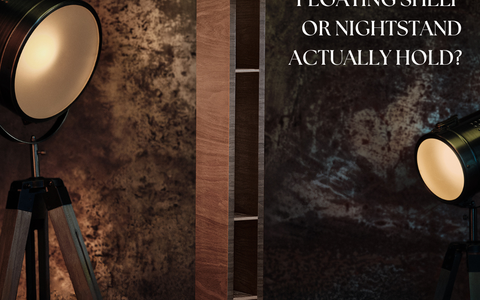
Our Brass Collection includes a wooden speaker shelf cabinet with three open levels. It measures 95 × 18.5 × 35.5 cm and weighs approximately 8.8 kg. Its narrow footprint makes it suitable for smaller listening corners where a wide media console would take up too much space.
Because it stands on the floor, the unit does not depend on wall fixings. You should still check the dimensions and confirmed load capacity before placing particularly heavy audio equipment on it.
If you are comparing different curved shelf shapes, our guide to EWART WOODS Wave shelves explains how the designs differ.

Where Should a Speaker Shelf Go?
For a living room or office, a useful starting point is to position the speaker so its tweeter is close to ear height when you are seated. Mounting it close to the ceiling may keep the wall tidy, but it can direct the sound above the listening position.
For a stereo pair, both speakers should normally be:
- at approximately the same height
- separated rather than placed directly beside one another
- positioned at a similar distance from the listening area
- installed according to the speaker manufacturer's guidance
Some speakers perform best with space behind them. Others are designed to sit closer to a wall. The position of the bass port and the manufacturer's instructions matter more than a universal placement rule.
Before drilling, use painter's tape to mark the shelf and speaker outline on the wall. Sit in the usual listening position and check the height, spacing and relationship to nearby furniture.
Avoid placing heavy audio equipment directly above a bed, doorway or frequently used seating position. Even with correct installation, it is better to place heavier objects where accidental impact or mounting failure would present less risk.
Wall Fixings Matter as Much as the Shelf
A 5 kg shelf rating only applies when the shelf has been correctly installed into a suitable wall.
Fixing into a wooden stud may be preferable when one is available, but appropriately rated drywall or masonry anchors can also be suitable. The correct option depends on the wall construction, the shelf and the total load.
Use mounting hardware intended for your wall type and follow its stated load limits. Do not use leftover anchors from another project simply because they fit through the mounting hole.
Our guide to why floating shelves sag or pull away from the wall explains the most common mounting problems in more detail.
Common Speaker Shelf Mistakes
The first mistake is checking only the speaker's weight. A speaker can fall below the shelf's weight limit and still be unsuitable because it is too deep or does not sit securely.
The second is forgetting the cable clearance behind the speaker. A cabinet may technically fit on the shelf while leaving no safe route for its power or audio cable.
The third is placing two speakers together simply because the shelf is long enough. Proper spacing matters for stereo sound, and a shared shelf can transfer vibration between the speakers.
The fourth is assuming isolation pads increase structural capacity. They can help control vibration, but they do not make the shelf or wall fixings stronger.
Finally, do not assume that a shelf suitable for books is automatically suitable for a speaker. Speakers concentrate their weight within a small footprint and produce movement while operating.
Before You Buy
Check these five things:
- The weight of each speaker
- The total weight of everything sharing the shelf
- The speaker's full depth, including cables
- Whether the base sits completely on a level surface
- Whether the wall and fixings are suitable for the load
A compact speaker can sit safely on a properly selected and installed floating shelf. But the speaker being under 5 kg is not enough on its own. It must also fit securely, have room for cables and ventilation, and be positioned on hardware appropriate for the wall.
If any of those points are uncertain, a flat shelf or floor-standing speaker cabinet is the safer choice. You can also browse our full shelf collection to compare shapes and dimensions before deciding.





Atstājiet savu komentāru