


How to Use Wood in a Bathroom (Without Getting It Wrong)
The article explains how to use wood successfully in a bathroom, covering why bathrooms are a distinct environment with moisture, small size, and fast repeated use, and what warmth wood adds against tile and chrome. It gives practical guidance on giving floating shelves a clear purpose, placing towel holders at 120-140 cm, using hooks, and choosing the right finish, placement, and coherent material story.
Wood in a bathroom divides people more than it should.
Some bathrooms are designed around it — wooden accessories, warm tones, materials that belong to the natural world rather than the industrial one. Others treat it as a risk: wood and moisture don't mix, so the whole category gets avoided in favour of chrome, glass, and ceramic.
The second position is overcautious. Wood and bathrooms are not incompatible. The question is which wood, with what finish, placed where — and what you put on it once it is up.
We make floating shelves, towel holders, hooks, and mirrors that go into bathrooms regularly. Over the years we have noticed what works and what doesn't. This is what we have learned.

Why Bathrooms Are Different From Every Other Room
Before thinking about wood specifically, it helps to understand what makes the bathroom a different environment from the rest of the home.
Bathrooms are used quickly and repeatedly throughout the day. A shelf or towel holder in a bathroom is accessed at close range, often before you are fully awake or in a hurry to be somewhere. Everything in the room needs to be either clearly useful or clearly there for a reason. There is less tolerance for objects that are just drifting, and less room for furniture that does not earn its place.
Bathrooms have moisture. Steam from a shower, condensation on surfaces, occasional splashes near the sink. This is not an extreme environment — a bathroom is not a sauna — but it is not the dry, stable environment of a bedroom or living room. Materials that would last indefinitely elsewhere age differently here. Finish matters more. Placement matters more.
And bathrooms are small. Most of them, anyway. Every object on a wall or surface competes for the same limited space, which means the decisions about what goes where have a bigger impact than they would in a larger room.

What Wood Actually Does in a Bathroom
The reason wood works in a bathroom is not purely aesthetic, though the aesthetic case is real. It is that wood belongs to a different material category from everything else typically found in bathrooms.
Ceramic tile, glass, chrome, brushed steel — these are all hard, cold, and reflective. They are practical, durable, and easy to clean, but they share a character that makes bathrooms feel clinical when there is nothing else present. Wood introduces something different: a material that is warm to the touch, quieter visually, and that reads as coming from somewhere other than a fitting catalogue.
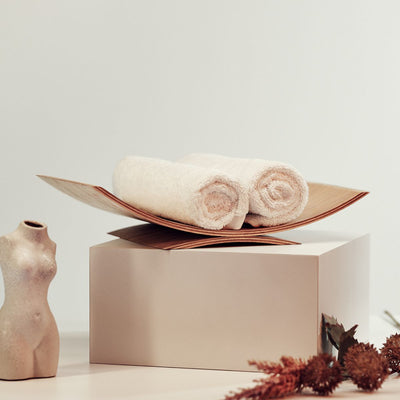
A wooden towel holder on a tiled wall. A wooden floating shelf above the sink. A wooden mirror frame. Each of these does what the object is supposed to do — hold towels, hold things, reflect — while also changing the temperature of the room in a way that no chrome equivalent manages.
The effect compounds. One wooden element in a bathroom is a detail. Two or three that share a material language make the whole room feel considered. This is not about decorating in a particular style. It is about the difference between a bathroom that feels assembled and one that feels designed.

Floating Shelves in Bathrooms
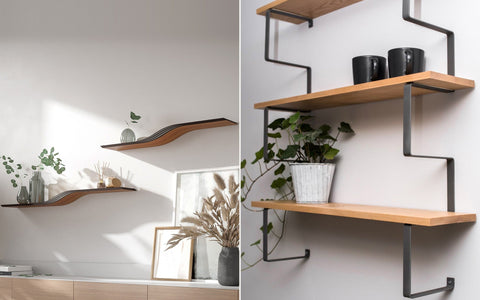
A floating shelf in a bathroom is one of the most useful additions a small bathroom can have, and one of the most reliably misused.
The misuse is almost always the same: the shelf goes up, and over the following weeks it fills with things that arrived there by habit rather than decision. A half-used bottle of something. Three different moisturisers. A candle that migrated from the bedroom. The thing you meant to put away.
This is not a discipline problem. It is a clarity problem. A bathroom shelf accumulates because most people put one up without deciding what it is actually for.
A shelf with a clear purpose stays edited. A shelf for the one plant you want in the bathroom. A shelf for the two or three products you use every morning. A shelf above the bath for the things you want within reach when you are in it. When the purpose is clear, objects that don't belong there don't land there — because they obviously don't fit.
What earns a place on a bathroom shelf: the products you reach for every day (not the full collection, just the current one), a single plant that tolerates humidity, a candle or two, one small functional object like a ceramic dish or soap holder.
What quietly takes over: products you are keeping just in case, things from other rooms that ended up there, multiples of the same product at different stages of being used up, anything with paper packaging or unfinished metal that the moisture will eventually get to.
Where a shelf sits changes what belongs on it. A shelf at eye level above the sink is accessed with wet hands in a hurry — everything on it needs to be stable and easy to grab. A shelf higher up, less accessible and more visible, is looked at more than reached for — a trailing plant, a single object with presence. A shelf lower down, if the layout calls for it, is for stored things rather than displayed ones.
The key question with a floating shelf in a bathroom is not what wood or what size. It is: what is this shelf actually for? Answer that first and the rest follows.
Towel Holders: The Detail That Affects the Room Most
Of all the wooden elements that can go into a bathroom, a towel holder has the most visible impact on how the room reads day to day. It is usually at eye level. It is on a wall that gets looked at regularly. And it holds something that is either hanging neatly or not.
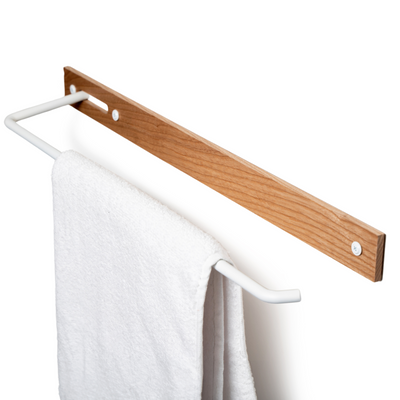
A wooden towel bar or rail introduces a horizontal element on the wall that is warm rather than reflective. In a bathroom with white tiles and chrome fittings, it is often the one thing that makes the room feel like someone chose it rather than just installed it.
Placement matters as much as the holder itself. The towel needs to be reachable the moment you step out of the shower — not after two steps across a wet floor. It needs enough air circulation to dry properly between uses, which rules out the back of the door (where the towel is pressed against the wall when the door opens, and barely dries). And it benefits from being on a wall the eye travels to naturally, rather than tucked into a corner where it is both hard to reach and invisible.
Height-wise, somewhere between 120 and 140cm from the floor works for most adults. Lower than that and a large bath towel drags. Higher than that and lifting a heavy wet towel becomes more effort than it should be.

Hooks: Underrated and Usually the Right Choice
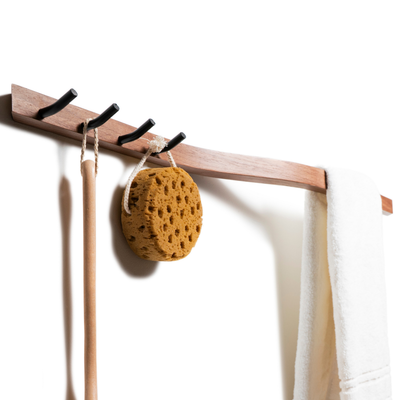
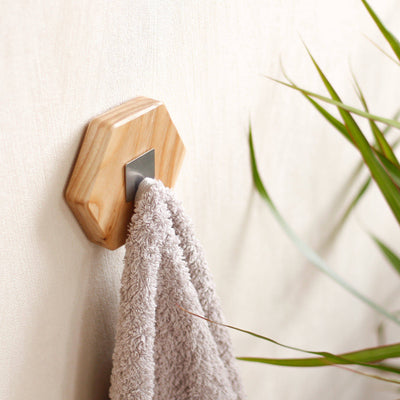
Hooks are the most underrated bathroom accessory. They are flexible, they take up almost no wall space, they can hold a towel, a robe, a bag, or a set of clothes, and they work in groupings in a way that a single towel bar does not.
A wooden hook beside the shower for the towel you use after it. Two hooks near the door for robes or clothes you don't want on the floor. A small hook beside the mirror for whatever needs to be close at hand.
Hooks also solve the towel drying problem differently from a bar. A bar spreads the towel open, which is best for overnight drying. A hook holds the towel bunched, which dries more slowly — but for a towel you use again within a few hours, not overnight, the difference is negligible. And in a bathroom where multiple people share towels, hooks at different heights make the system immediately obvious: each person has a hook.
What to Think About Before Adding Wood to a Bathroom
Wood in a bathroom works when a few conditions are met.
The finish. This is the only thing that separates wood that lasts in a bathroom from wood that doesn't. An unfinished or poorly sealed wooden surface in a bathroom will eventually show it — swelling slightly, losing its surface quality, looking worn before its time. A well-sealed surface handles bathroom conditions without issue. When choosing any wooden bathroom accessory, it is worth confirming that the finish is appropriate for the moisture environment, not just the aesthetic one.
The placement. Wood that is regularly submerged or in direct contact with standing water is a different situation from wood that lives in a bathroom with normal moisture levels. A shelf above the sink is fine. A shelf that water pools on from above the shower is a different matter. Placement away from the most intense water contact points is the simple rule.
The coherence. One wooden element in a bathroom is a detail. Multiple wooden elements in the same material — a shelf, a towel holder, a mirror frame — create a coherent material story that makes the room feel more considered than any single piece could achieve alone. This is worth thinking about if you are adding to a bathroom gradually rather than all at once. Each piece should share enough material character with the others to read as related.

Products related to this article





Frequently asked questions
Can you use wood in a bathroom?
Yes. Wood and bathrooms are not incompatible; the question is which wood, with what finish, placed where. A well-sealed wooden shelf, towel holder, or mirror frame handles normal bathroom moisture without issue.
Will wooden bathroom accessories get damaged by moisture?
The finish is what separates wood that lasts from wood that does not. A well-sealed surface handles steam and condensation fine, while unfinished wood eventually swells and looks worn. Keep wood away from standing water and direct, repeated water contact.
Where should a wooden shelf go in a bathroom?
Above the sink or elsewhere with normal moisture levels, not directly where water pools from the shower. Decide what the shelf is for first: daily products at eye level, display items higher up, or stored things lower down.
What height should a towel holder be mounted?
Between 120 and 140 cm from the floor works for most adults. Lower and a large bath towel drags; higher and lifting a heavy wet towel becomes unnecessary effort.
Where is the best place for a towel holder?
Within reach of the shower so you do not cross a wet floor, with enough air circulation for the towel to dry, and on a wall the eye naturally travels to. Avoid the back of the door, where towels get pressed flat and barely dry.
Are hooks or a towel bar better?
Both have a role. A bar spreads the towel open for overnight drying, while hooks take almost no wall space, work in flexible groupings, and make shared bathrooms simple since each person gets a hook.
What belongs on a bathroom shelf?
The products you actually use every day, one humidity-tolerant plant, a candle, and one small functional object like a soap dish. Avoid just-in-case products, duplicates, and anything with paper packaging or unfinished metal.
How do I make a bathroom feel less clinical?
Add warm natural material against the tile and chrome. One wooden element is a detail, but two or three in the same material, like a shelf, towel holder, and mirror frame, create a coherent story that makes the room feel designed. EWART WOODS makes these handmade in Europe.




Legg igjen en kommentar