


Wood in Your Gaming Setup: The Cozy Battlestation Guide
Most gaming desks have the same problem: too much plastic, too many cables, and a monitor sitting at a height that's quietly wrecking your neck. The fix people usually reach for is more RGB, more shelving units from a big-box store, more stuff. The better fix is usually less — a few solid pieces that actually do something, instead of ten cheap ones that don't.
Here's where wood earns its place at a desk, and where it's really just decoration.
The Problem Is Height, Not Style
Before anything else, fix the monitor height. When a screen sits flat on the desk, you end up looking down and hunching forward for hours at a time — that's the posture problem, not the aesthetic one. A riser that lifts the screen to eye level solves it, and it has a second benefit most people don't think about until they have it: it opens up a dead zone underneath where a keyboard, controller, or cable mess can disappear when you're not using it.
We make three versions of this because "monitor riser" isn't one product. If you want the desk to look like furniture rather than gear, there's a live-edge version with a bark border and metal legs. If you want the underside to double as real storage instead of just open space, there's a version built with storage compartments underneath. The one we'd point most people to first, though, is the curved monitor stand — it comes in walnut, ash, oak, cherry, or wenge, all solid wood, and reads as the most versatile of the three.
Worth being precise here: these are solid wood pieces, not plywood. That matters for how they age — solid wood shows grain and takes a scratch differently than an engineered panel would, which is part of the appeal if you like a desk that looks like it belongs in a house and not a server room.

Where Plywood Actually Is the Better Choice: Floating Shelves
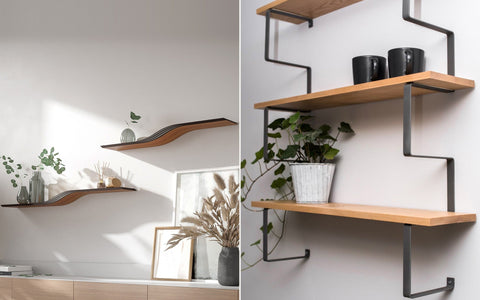
Above the desk is a different structural problem, and it calls for a different material. A shelf mounted to a wall is under constant load-bearing stress in a way a desk riser isn't, which is exactly why our floating wall shelves are built from Baltic birch plywood with a wood veneer finish, not solid boards. Plywood's cross-laminated layers resist the sagging and warping that solid wood or MDF can develop over time under sustained weight — which is the actual reason to care about the material, not just a spec sheet detail.
That's the shelf to use for the stuff that shouldn't be on the desk at all: the mechanical keyboard you're not using, a couple of collectibles, a small trailing plant if you want a bit of green near the setup. Getting things up onto the wall is the single biggest change most cluttered desks need — more than any new accessory.
If you want the actual research behind why natural materials in a workspace tend to feel calmer than an all-plastic one, we go into that properly in Biophilia 2.0: The Science of Using Wood to Build a Stress-Free Sanctuary — worth a read rather than us asserting it again here without the sourcing.
A Real Setup, Styled Around the Wave Shelf
Theory is one thing — here's what it actually looks like in a real room. One customer built their whole desk setup around our Wooden Floating Wall Shelf Curved Wave, mounted above a dual-monitor station and styled with a small potted plant, a framed photo, a ceramic teapot, and a couple of plushies tucked along the curve of the shelf. Underneath, the desk keeps the same restraint: a pastel mechanical keyboard, a console dock, and a monitor stand doing exactly the job we described above — nothing crammed on the surface that doesn't need to be there.
It's a good example of the actual point of this piece: the shelf isn't just storage, it's what lets the rest of the desk stay calm.

(Credit: @jesskindareads)
(Credit: @dailyalissa_)
Clearing the Small Stuff Off the Desk
Once the monitor's up and the shelf is doing its job, what's usually left is small clutter: headphones, a phone, loose cables. A headphone holder in metal and wood keeps a headset off the desk surface entirely, which matters more than it sounds — resting expensive earcups directly on a desk mat is a fast way to scuff them. Beyond that, our full office and desk organizer collection covers the rest: trays, stands, and small holders for whatever's still floating around loose.

Cable Management Is the Boring Part That Actually Matters
Wood accents lose their effect fast if there's a nest of cables running across them. A few things that make the biggest difference:
- Route keyboard and mouse cables directly under the riser rather than across the desk
- If you're running lights or a dock up to a floating shelf, keep the wire behind the mounting bracket, not draped over the front edge
- Match cable colors to the finish — black or white cords against a wood tone read as intentional; a tangle of random colors doesn't
None of this needs a full setup rebuild. Fix the monitor height first, get the clutter up onto a shelf second, and clear the small stuff last — in that order, not all at once.





Legg igjen en kommentar